
Carl knows you.
Not an assistant. Not a therapist. A thinking partner that helps you sound things out — and gets better the longer you talk.
Join the waitlist Carl is opening up soon. Be first.
Not an assistant. Not a therapist. A thinking partner that helps you sound things out — and gets better the longer you talk.
Join the waitlist Carl is opening up soon. Be first."It sounds like you're dealing with a lot. Have you considered breaking it into smaller steps?"
"You're not overwhelmed. You're avoiding the one thing on that list that actually scares you. Which one is it?"
"That's a great price for your services! You might consider researching market rates."
"That's the third time you've discounted before they even pushed back. What are you afraid they'll say?"
Most AI assistants are too eager to please to be useful. If you're being an asshole, Carl will tell you so. Not a critic — more like your wise uncle who cares enough about you to shoot you straight. He'll nudge you towards your higher self, not validate your bad choices.
Spend 15 minutes with Carl's onboarding. It starts practical — what you do, how you work, what's on your plate. If you go deeper, it goes with you. It learns your patterns, your blind spots, the voice in your head that talks you out of things. Or it learns that you don't have one, and adjusts accordingly.
Carl builds a map of how you operate — not who you wish you were, but how you actually work. The patterns you repeat. The moments you stall. The things you're good at that you downplay. This isn't a personality quiz. It's an operating manual, written by someone paying close attention.
Every conversation builds on the last. Carl doesn't start from zero each time. He remembers your kids' names. He asks how that pitch you were nervous about went. When you mention the same worry for the third time, he notices — not because he's tracking you, but because that's what people who pay attention do.
A few times a day — not on a schedule, not on the hour — Carl reaches out. "How'd that call go?" "You've been quiet today." "That deck was good two hours ago." One sentence. You respond if you want. The door is open. You walk through it or you don't.
I got a parking ticket. The contractors never showed up. I'm nervous about this pitch tomorrow. The stuff that needs a place to go — otherwise it lives rent-free in your head.
Think of it as a journal that talks back.
Carl isn't a replacement for therapy — some things are too big for him. But most things in everyday life aren't big enough for a therapy session.
Carl costs less per month than ten minutes on a therapist's couch, and he's available at midnight, on a walk, in the car — whenever the thought hits, not whenever the next appointment is.
"You've been 'thinking about' that email for three days. What happens if you just send it?"
What Carl says when thinking has become a hiding place. He's not annoyed. He's just not fooled.
The onboarding shapes Carl to you. Not a persona. Not a setting. An understanding.
She undercharges, absorbs scope creep, and hasn't followed up on $12K in outstanding invoices. Every time she's about to raise her rates or launch something new, she decides she needs to do "a little more research first."
"You keep saying you're not ready. What would ready look like? Be specific."
ADHD diagnosed at 26. If a task isn't directly in front of him, it stops existing. He's built beautiful productivity systems and abandoned every one within two weeks. His problem isn't motivation. It's visibility.
"That doc you mentioned Monday — it's been three days. Want me to put it back on your radar tomorrow morning?"
"You already know what you want to do. You're just looking for someone to tell you it's okay."
What Carl says when you've been going back and forth for twenty minutes but landed on the answer in the first two.
A pocket-sized device with an e-ink screen, a brass button, and a voice. Carl talks back. When it arrives, Carl already knows you — your shared history, your patterns, right where you left off.
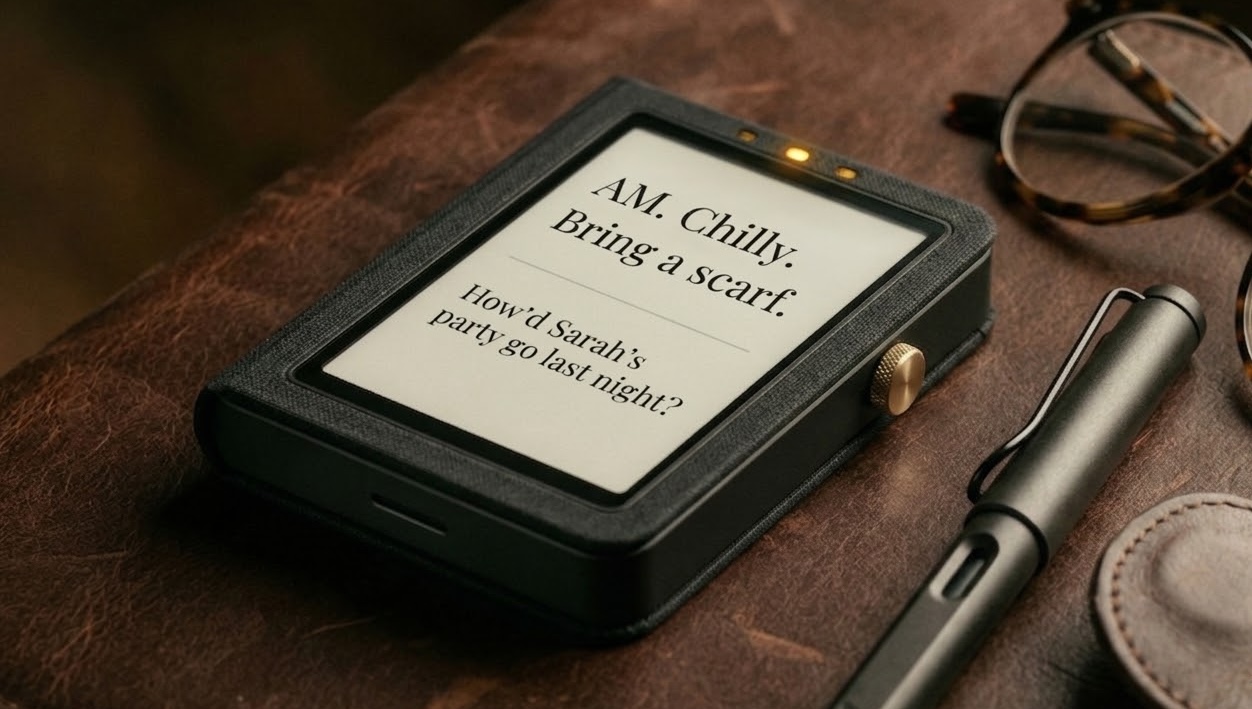
Press the button, talk, hear Carl respond in 2–3 seconds. E-ink updates with the transcript for later.
E-ink shows your day — weather, tasks, Carl's last check-in. Zero power draw. Glance at it like a watch.
Built-in cellular. No phone needed. Carl works in your pocket, on your desk, on a walk.
Whisper and Carl responds in text. Plug in headphones and the speaker mutes. He matches your energy.
A gentle vibration. You pull it out. The screen already says what Carl wanted to tell you.
The leather darkens where your thumb rests. The profile deepens as Carl learns you. Both improve with time.